
Review · NAPLES
Pompeii & Herculaneum Guided Tour – High Speed Train from Rome
Ancient cities, one long day. This Rome to Pompeii and Herculaneum tour makes southern Italy possible without changing hotels or wrestling with local trains. You travel by high-speed rail from Rome, meet your guide in Naples, then use a private minibus and included entrance tickets to reach both archaeological sites.
I like the archaeologist-led visits, which bring ordinary Roman life into focus, and the simple Naples transfer, which removes much of the day’s transport hassle. The main drawback is the pace: Pompeii and Herculaneum require plenty of walking, and the 11-hour-30-minute schedule leaves limited time for wandering on your own.
Key points to know before booking
- High-speed rail from Rome: You travel independently from Roma Termini to Naples, then meet the group near Naples Central Station.
- Two very different ancient cities: Pompeii is huge and urban, while Herculaneum is smaller and often feels more intimate and better preserved.
- Licensed archaeologist guides: Guides such as Michele, Alfredo, Raphael, Paolo, Roberta, and Gennaro have been praised for clear explanations, humor, and a strong grasp of daily Roman life.
- Maximum group of 20: This is not a private tour, but it is more manageable than a large coach outing.
- A useful midday break: The 50-minute stop at Maximall Pompeii provides restrooms, air conditioning, food options, a welcome kit, and a discount card.
- Demand is strong: The tour is often booked about 86 days ahead, so popular dates may require planning.
Why this Rome day trip works
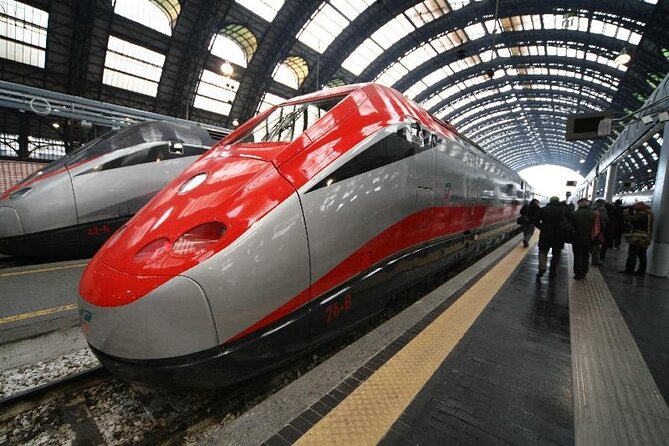
The great strength of this experience is efficiency. You leave Rome by high-speed train, meet the local team in Naples, visit two major archaeological parks, and return to Roma Termini the same evening. For a first visit to Italy, that saves you from arranging rail tickets, local transfers, entry reservations, and separate guides.
The tradeoff is easy to understand. You are trying to see two large archaeological areas in one day, so this is a highlights visit, not a complete examination of Pompeii. One of the most useful comments from the day’s feedback was that Pompeii alone could take many hours, and that is exactly the point to keep in mind.
The advertised price is $204.38 per person. That is not cheap, but it includes round-trip high-speed rail, entrance tickets to both sites, minibus transport from Naples, an archaeologist guide, headsets, and the local coordination. Adult admission alone totals 36 euros, based on the stated 20-euro Pompeii ticket and 16-euro Herculaneum ticket. If you value your time and want one organized day from Rome, the price can make sense.
If you are comfortable arranging trains and site tickets yourself, you could spend less. You would also take on the risk of navigating Naples, finding transport to Pompeii and Herculaneum, and getting back to Rome on schedule. This tour sells convenience as much as sightseeing.
More High-Speed Trains in Italy
- Rome to Pompeii Guided Tour with Wine & Lunch by High Speed Train
★ 5.0 · 1,379 reviews - Rome: Pompeii Tour with Wine and Lunch by High Speed Train
★ 4.8 · 485 reviews - Venice Day Trip from Rome by High-Speed Train with Happy Hour
★ 4.5 · 445 reviews
Your morning begins at Roma Termini
You start on your own at Roma Termini Station. The high-speed train tickets are sent to you one day before departure, so you do not meet the guide in Rome. You simply find your train, board, and travel south.
That independence is both easy and important. You need to be comfortable reading your ticket, reaching the correct platform, and managing your own transfer in Naples. The train ride itself takes about an hour according to the planned schedule, leaving the more complicated part for the station arrival.
Check the destination carefully. The supplied guidance warns that there are two Naples stops on the rail journey, so wait for the correct arrival at Napoli Centrale. The meeting point is the Starhotels Terminus at Piazza Giuseppe Garibaldi, directly across from Naples Central Station.
This is a practical location. You do not need to cross the city or figure out a local subway connection. Give yourself enough time to walk across the square, find the hotel, and meet the Askos Tours guide and driver.
Meeting the group near Naples Central Station
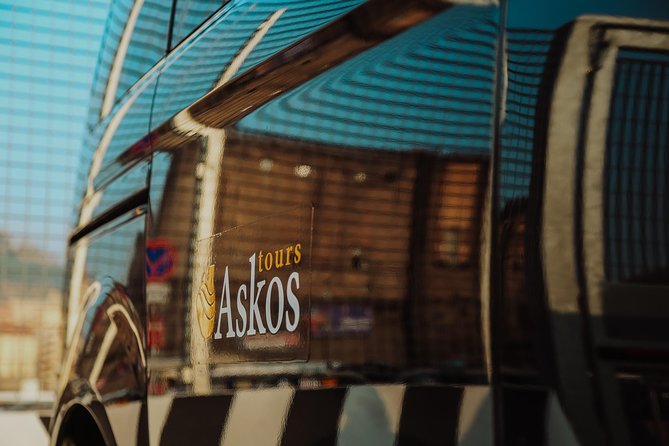
The Naples meeting stage is scheduled for about 30 minutes, including the transfer setup. From here, a minibus takes the group toward the archaeological sites.
The group limit is 20 people. That is small enough for a guide to keep people together, though it does not guarantee a quiet visit. Pompeii can be crowded, and one person found the Pompeii portion busier than expected. Headsets are included, which should help you hear the guide while moving through the ruins.
The equipment is useful, but it is not magic. One account described the bus intercom as difficult to hear, and another noted that the headsets could cut out when the guide walked too far ahead. Stay near the guide, especially in crowded areas, and speak up quickly if the audio fails.
The drivers also receive repeated praise for keeping the day on track. Giuseppe, Massimo, and Salvatore are among the drivers named in the feedback. The driver’s job matters here because the schedule depends on two site visits, a shopping-center break, and a train back to Rome.
Pompeii begins at Porta Marina
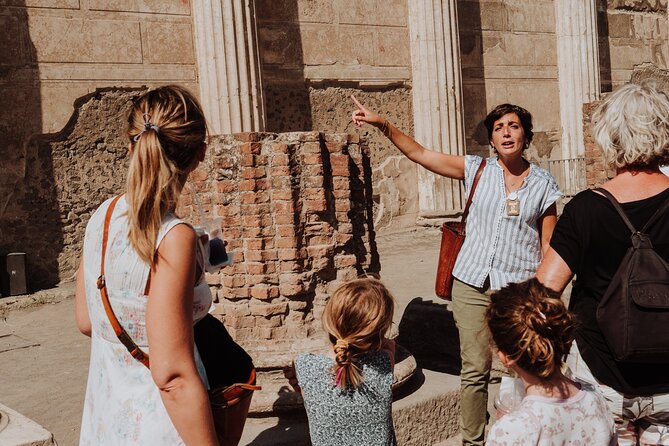
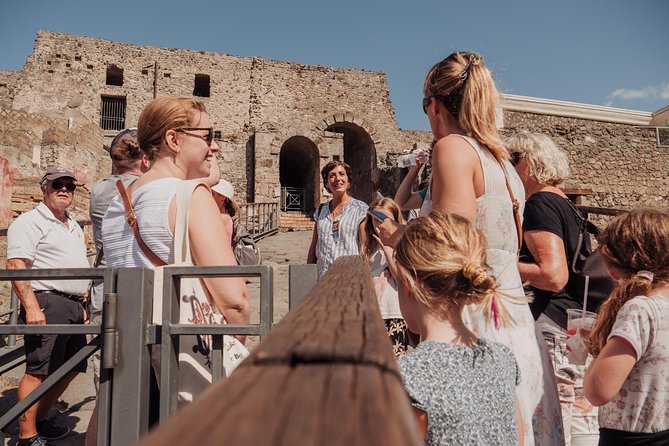
The Pompeii visit starts at Porta Marina, one of the ancient city’s main entrances. Your archaeologist guide introduces the city’s layout, the eruption of 79 AD, and the way streets, houses, public buildings, and shops fitted together.
Pompeii is enormous compared with Herculaneum. You will not see everything in the available time, but the route covers a useful range of buildings and public spaces. The guide’s explanations are especially valuable because a paved street or ruined wall can look like a pile of stones without context.
Via dell’Abbondanza gives you a sense of Pompeii as a working city. This major street connects several important stops and helps you understand movement through the ancient town. You will walk across uneven Roman paving, so supportive shoes are a must.
The House of Menander offers a look at an upscale private residence, while the Forum granaries provide a more practical view of food storage and the way excavated objects help archaeologists explain daily life. These contrasts are part of what makes Pompeii worthwhile: grand houses and ordinary systems appear side by side.
Same tracks, a different day out:
- From Milan: Lake Como Cruise, St. Moritz & Bernina Red Train
★ 4.6 · 5,648 reviews - From Milan: Bernina Train and St. Moritz Day Trip
★ 4.5 · 4,495 reviews - Bernina Red Train, Swiss Alps & St Moritz From Milan
★ 5.0 · 2,954 reviews - Swiss Alps Bernina Red Train and St.Moritz Tour from Milan
★ 4.5 · 2,369 reviews
Baths, theater, and the House of the Faun
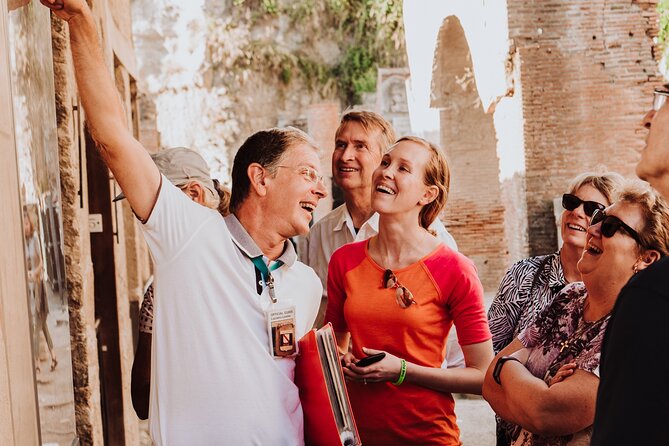
The Stabian Baths show the public side of Roman life. Your guide can help explain how bathing worked as a social routine, not simply as a place to wash.
The Lupanar, or brothel, is one of Pompeii’s most famous stops. It is small, direct, and often crowded. You may find this stop interesting for what it reveals about Roman commercial life, though it is not the place to expect a long, quiet visit.
The House of the Faun shifts the focus back to elite domestic life. Its scale and decoration help explain the gap between wealthy households and the city’s working population. The name comes from its famous faun statue, and the house is one of the better-known residences on the route.
At the Odeon, or Small Theater, you see a more intimate performance space. The Great Theater provides a larger public setting and helps you picture entertainment as a regular part of city life. These stops also break up the walking, though both remain part of a fairly active morning.
The guide is the deciding factor here. Raphael has been praised for making the ancient residents feel like real people, while Michele has been singled out for linking archaeology, geology, and the city’s destruction. Alfredo has been credited with adjusting the pace to the group and answering questions carefully. Your exact guide may vary, but the tour depends heavily on this person’s delivery.
The Maximall Pompeii break
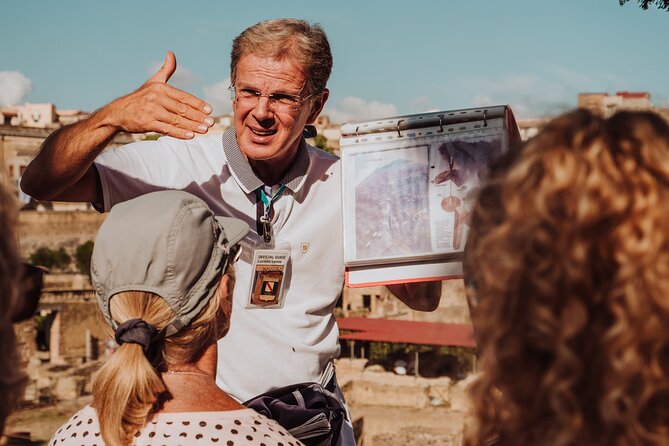
After the first stretch at Pompeii, the group stops for about 50 minutes at Maximall Pompeii, described as the largest shopping center in southern Italy. You receive a branded welcome kit and discount card with special offers in the stores.
This is not an ancient-world highlight, but it serves a real purpose. Pompeii has little shade, and several hours over uneven roads can tire your feet. The shopping center offers air conditioning, restrooms, food choices, and a chance to sit down before the second archaeological site.
One family especially liked this break because it gave children time to rest. Another person called the lunch stop quick but useful. Do not treat it as a leisurely meal. You have a set departure time, so keep lunch simple and return to the meeting point promptly.
The stop may feel commercial after a morning among ruins. Still, on an 11-hour-30-minute day, a practical break can make the difference between enjoying Herculaneum and merely enduring it.
Herculaneum gives you a closer look
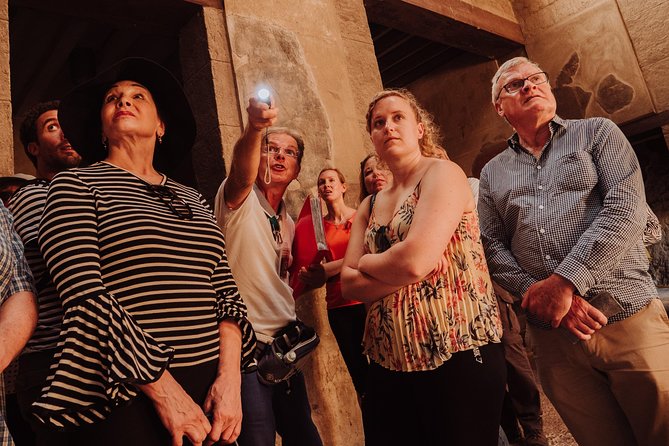
Herculaneum is scheduled for about two hours. That is shorter than the total Pompeii route, but the site itself is smaller and more compact.
The contrast between the two cities is one of the best reasons to book both. Pompeii gives you breadth, with streets, theaters, baths, shops, and large houses spread across a vast area. Herculaneum offers a tighter view of homes, decoration, and preserved interiors.
The House of the Deer is a strong stop for seeing how an affluent household used terraces and views. The Terrace of Marcus Nonius Balbus adds a public and commemorative element, while the College of the Augustales helps explain religious and civic life.
Herculaneum is often the surprise favorite. Its mosaics, frescoes, wood, and interior details can feel more immediate than Pompeii’s broad streets. One guide used the smaller site first as preparation for Pompeii’s scale, while another made a point of showing how the two cities offered different stories rather than repeating the same visit twice.
The homes and baths of Herculaneum
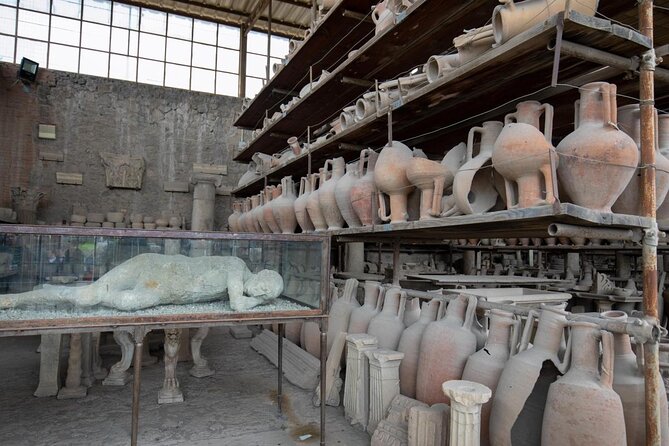
The House of the Wooden Partition is notable for its surviving wooden feature, an unusual reminder that ancient buildings were not made only of stone. The House of the Skeleton adds a darker note and shows why archaeological interpretation matters. You are looking at a site shaped by sudden catastrophe, not a neatly abandoned town.
The Central Thermae returns you to the Roman bathing system. The House of the Relief of Telephus, Samnitic House, and House of the Fine Courtyard add variety to the domestic route. You move through different scales of residence, decorative styles, and architectural plans.
The House of the Grand Portal and the House of the Black Salon continue that close look at private interiors. Herculaneum rewards attention to small details, so listen for the guide’s explanation of construction, decoration, and excavation. Without that help, some of the most useful evidence can be easy to miss.
Two hours is enough for a strong introduction, but not enough for every corner. You will need to keep moving with the group. If you like to stop for long photography sessions or read every sign, this combined itinerary may feel rushed.
How hard is the walking?
This is a physically active day. Both sites involve uneven ancient roads, and Pompeii has very little shade. One direct warning from the feedback was that the route can be strenuous on the feet, especially for anyone with leg or knee problems.
Wear sturdy, comfortable shoes. Bring water, sun protection, and a hat if the weather is warm. Meals and drinks are not included, so plan to buy food during the Maximall break or carry what you need.
The tour is not recommended for visually impaired participants unless they have a dedicated personal assistant. Most people can take part, but the long day, uneven surfaces, and quick transitions make this a poor match for anyone who needs frequent rest or a slower pace.
Returning to Rome without a scramble
After Herculaneum, the minibus returns you to the Starhotels Terminus near Naples Central Station. From there, you reach your platform and board the high-speed train independently for Roma Termini.
The schedule appears deliberately conservative. Several people appreciated the smooth return, while one person felt the group reached the station nearly two hours before the train and could have spent more time at Pompeii. That is the basic tension: arriving early protects you from a missed train, but it costs you time inside the ruins.
I prefer this cautious approach on a day trip from Rome. A missed evening train would turn a long sightseeing day into a serious problem. Still, you should understand that the operator may prioritize a safe rail connection over squeezing in one more building at Pompeii.
Who should book this experience?
I would choose this tour if you have limited time in Rome and want to see both ancient cities in one organized day. It is especially good for first-time visitors who want a guide to explain what they are seeing rather than simply walk through the ruins alone.
It also suits families who can manage a full day on their feet. The minibus, included rail tickets, clear Naples meeting point, and rest break remove several stressful parts of the journey.
I would hesitate if Pompeii is your main passion. You may want a dedicated full-day visit there, with time to explore less famous streets and buildings at your own speed. I would also hesitate if you have mobility concerns, dislike fixed schedules, or prefer independent travel.
The strongest reason to book is the guide. Names such as Alfredo, Raphael, Michele, and Gennaro appear repeatedly in praise for clear explanations, humor, and the ability to connect buildings with the people who used them. The weakest point is the unavoidable compression of two major sites into one day.
Should you book it?
Book it if you want the most efficient Rome-based route to Pompeii and Herculaneum, value an archaeologist’s explanation, and accept a brisk walking schedule. The rail and minibus arrangements are worth real money, especially when you consider the risk of missing a return train.
Skip it if you want a slow, exhaustive Pompeii visit or need plenty of unstructured time. For most fit first-time visitors, though, this is a well-organized introduction to two extraordinary sites, with Herculaneum providing the intimate counterpoint to Pompeii’s enormous scale.
FAQ
Where does the tour begin?
You begin independently at Roma Termini Station. Your high-speed train tickets are sent one day before the tour, and the guide does not meet you in Rome.
Where do I meet the guide in Naples?
Meet at the Starhotels Terminus at Piazza Giuseppe Garibaldi, directly across from Naples Central Station. The guide and Askos Tours driver will take the group to the archaeological sites.
Is transportation from Rome included?
Yes. The tour includes round-trip high-speed train tickets between Roma Termini and Naples, plus minibus transportation from Naples Central Station to the sites and back.
Are Pompeii and Herculaneum entrance tickets included?
Yes. The package includes Pompeii Express admission and entry to the Herculaneum ruins. The stated adult ticket prices are 20 euros for Pompeii and 16 euros for Herculaneum.
How long is the full experience?
The planned duration is about 11 hours and 30 minutes, including the train journeys, Naples transfers, guided visits, break, and return to Rome.
How much time do I spend at each archaeological site?
The Herculaneum visit is scheduled for about two hours. The Pompeii portion includes several stops before and after the Maximall Pompeii break, with the total site time described in the supplied feedback as roughly two and a half hours.
Is the tour conducted in English?
Yes. The available tour language is English.
Can I bring a suitcase?
Suitcases are not recommended because the minibus may not have a luggage compartment. Use a luggage deposit at the station or another suitable facility during the excursion.
What is the cancellation policy?
You can cancel for a full refund up to 24 hours before the local start time. Cancellations or changes made less than 24 hours before the start are not accepted for a refund.
Just added around Italy
- Verona Private City Tour including Arena and Funicular for Kids and Families★ 5.0 · 6 reviews
- Private Full Day Tour from Milan to Venice with local tour guide and fast train★ 4.5 · 3 reviews
- Venice Tour by High-Speed train from Florence★ 5.0 · 6 reviews
- Venice Beginner’s Kayak Tour: train & visit the Medieval Arsenal★ 5.0 · 5 reviews
- Etna Wine Tasting and Train Tour★ 4.0 · 8 reviews
- Private Tour of Rome from Florence in fast train★ 5.0 · 2 reviews
- Florence from Rome by High Speed Train at your pace★ 4.5 · 11 reviews
- Venice Day Trip from Rome: Private Tour by High Speed Train★ 4.0 · 58 reviews
High-Speed and Bullet Trains, compared.

Mt Fuji & Hakone Cruise, Drum Show Bullet Train 1 Day from Tokyo
Read our review →
Tokyo Mt Fuji 5th St & Hakone Cruise Bus Tour w/Bullet Train
Read our review →
Taj Mahal & Agra Tour by Gatimaan Express Train
Read our review →
Pompeii Tour with Wine and Lunch by High Speed Train
Read our review →
Venice Day Trip from Rome by High-Speed Train with Happy Hour
Read our review →
Mt. Fuji and Hakone Day Trip From Tokyo with Bullet Train Option
Read our review →
Suzhou Private Day Trip from Shanghai with Bullet Train Option
Read our review →
Browse the lists this tour appears in