
Review · KYOTO
Train Katana with Real Dojo Students in Kyoto
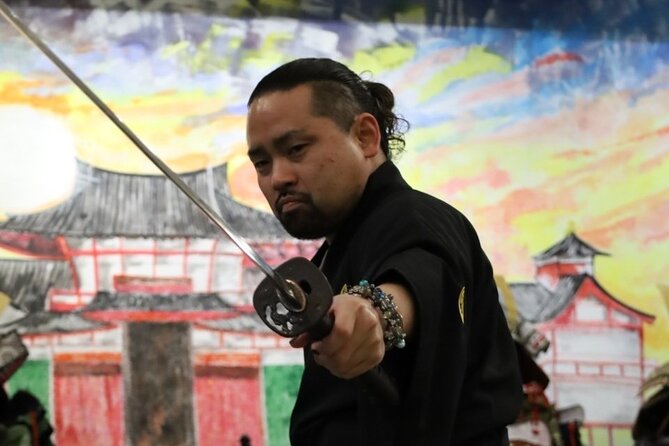
Steel meets tradition here. This three-hour Kyoto session takes you into Yushinkan Kyoto, a working dojo where local students train with a master who has more than 20 years of experience. I like the small maximum of three participants, and I like that you wear proper dōgi, obi, and hakama rather than posing in a costume. The main consideration is that this is serious training, not a relaxed samurai photo stop, and a moderate level of fitness is expected.
You will learn basic iai, the art of drawing the katana, and kenjutsu, or sword-fighting technique. You will also watch students and the master cut rolled tatami mats with real swords. Since video recording is not allowed and test cutting is not offered to participants, this experience suits people who care more about practice and observation than collecting dramatic footage.
Key points to know before you book
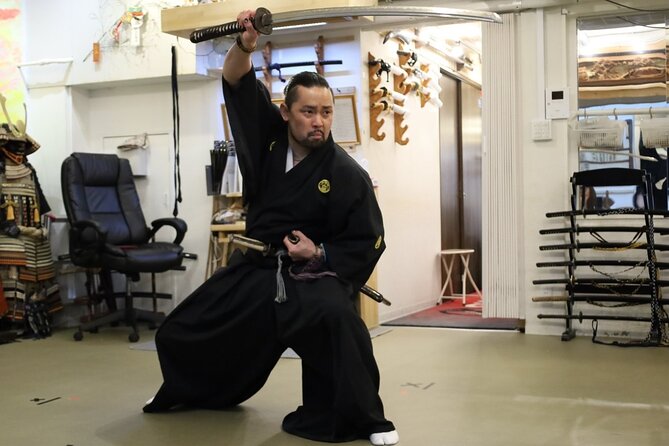
- Train beside real dojo students: You join an active class rather than a show built only for tourists.
- Wear full training clothing: The dōgi, obi, and hakama help you approach the session with the right focus and respect.
- Learn iai and kenjutsu: The lesson covers both controlled sword drawing and fighting techniques.
- Watch real tatami cutting: Students and the master demonstrate test cutting, but you will not cut mats yourself.
- See a two-katana performance: The master’s performance is a rare part of the session and one of its most memorable features.
- Expect a tiny group: No more than three participants can join, which allows close attention but also makes the booking less flexible.
Entering a working Kyoto dojo
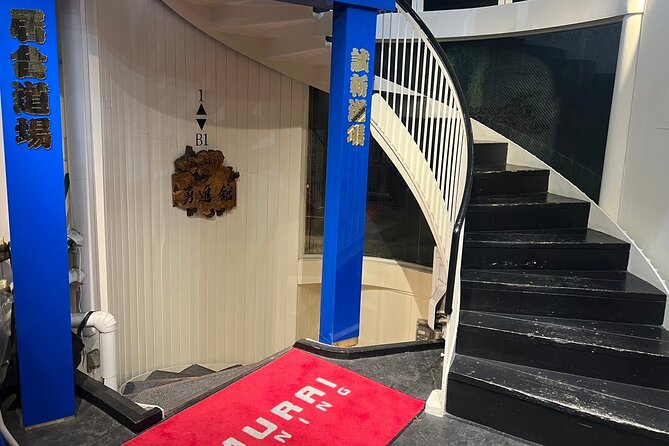
The meeting point is at 452-4 Matsugaechō in Nakagyo Ward, Kyoto, postal code 604-8034. The dojo is near public transportation, and the activity begins and ends at the same place. That simple arrangement matters in Kyoto, where a compact experience can fit neatly into a morning or afternoon without sending you across the city.
The first thing to understand is the tone. This is not presented as a staged samurai attraction. Yushinkan Kyoto is home to students who train regularly and seriously. You are stepping into their practice, with permission to take part under instruction.
That difference changes the experience. A costume rental can give you a photograph in a few minutes. Here, the clothing is part of the training setting. You put on a dōgi, tie an obi, and wear hakama before learning how the sword is handled. The clothes will not turn you into a samurai, but they do signal that the session has rules, posture, and discipline.
The master leading the dojo has more than two decades of experience. His name is not supplied in the booking information, so do not expect a named celebrity swordsman. The value comes from his role as a working instructor and from the chance to watch him guide both local students and a very small number of visiting participants.
More Train Journeys in Japan:
- Mt Fuji & Hakone Cruise, Drum Show Bullet Train 1 Day from Tokyo
★ 4.0 · 7,413 reviews - Tokyo Mt Fuji 5th St & Hakone Cruise Bus Tour w/Bullet Train
★ 4.4 · 5,024 reviews - Mt. Fuji and Hakone Day Trip From Tokyo with Bullet Train Option
★ 4.0 · 368 reviews
Why the three-person limit matters
With a maximum of three participants, this is far more personal than a large group demonstration. You should have a better chance to see the instructor’s movements clearly and receive direct correction during the basic exercises.
There is also a practical tradeoff. A class this small has very limited capacity, which may explain why people book it an average of 29 days ahead. Confirmation is sent within 48 hours, subject to availability, so do not leave this until the last few days of your Kyoto stay.
The small group also means the session depends on your attitude. You are not one face in a crowd. Your attention, movement, and respect for the dojo will be visible. That is good news if you want close instruction. It may feel more demanding if you hoped to stand back and let others do the work.
Participants must be at least 12 years old. The activity also calls for moderate physical fitness. The supplied details do not specify how long you will stand in each position or how strenuous each exercise becomes, so anyone with concerns should consider that requirement carefully before booking.
Getting dressed in dōgi, obi, and hakama
The clothing stage gives the session a clear beginning. You change into traditional training gear rather than ordinary street clothes. The dōgi provides the basic uniform, the obi secures the waist, and the hakama gives the outfit its familiar wide-legged shape.
This is not just decoration. Martial arts clothing helps create a consistent setting for movement. It also asks you to behave differently from someone posing for a quick photograph. You will need to pay attention to how you stand, how you hold the sword, and how you move around others.
The clothing may also be a consideration if you dislike restrictive garments or have trouble with extended standing. The experience description does not promise changing-room details, so keep your planning simple and arrive ready for a focused class rather than a spa-like comfort stop.
Learning iai, the controlled art of drawing
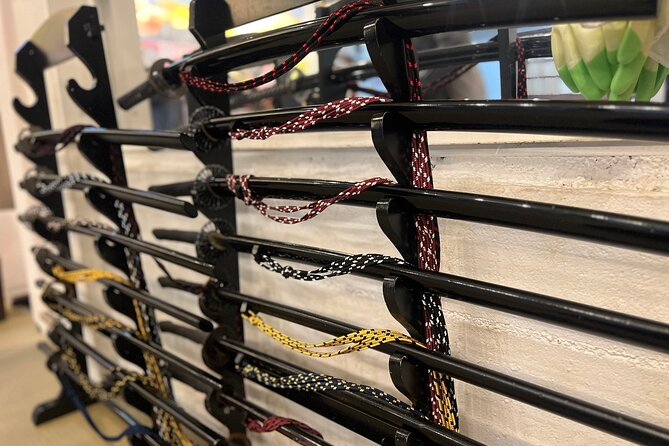
The first technical lesson covers iai, or katana drawing. The name refers to the controlled act of drawing the sword, using it, and returning it with precision. Even at an introductory level, this is not a matter of swinging a prop around.
You will be asked to pay attention to position, timing, and control. The point is not speed. A fast movement without control would miss the central lesson. Iai shows why sword training is tied closely to posture and concentration.
For someone with previous martial arts experience, this portion may be especially rewarding. One participant with experience in several martial arts but limited katana practice described the session as a good fit and praised the professional arrangement. That is useful guidance: a background in martial arts is not listed as compulsory, but it may help you understand the demands of the instruction more quickly.
If you have never studied a martial art, you can still appreciate the principles, but do not expect to master the movements in one visit. Three hours gives you an introduction, not a full course.
Same tracks, a different day out:
- From Osaka: Sagano Train Ride and Kyoto Guided Day Tour
★ 4.3 · 180 reviews - Fukuoka: Takachiho Gorge & Scenic Railway One Day Tour
★ 4.8 · 178 reviews - Sagano Romantic Train & Arashiyama, Kiyomizudera, Fushimi Inari Taisha Day Tour
★ 4.5 · 171 reviews - Hakone: Train Pass with Unlimited Rides & Activity Discounts
★ 4.4 · 102 reviews
Practicing kenjutsu without the movie theatrics
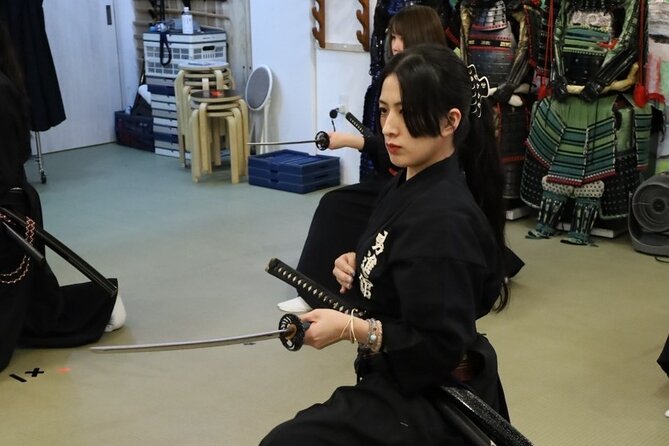
The session also introduces kenjutsu, the broader practice of fighting with a sword. This is where many visitors may arrive with film-inspired expectations. Real training is more controlled and less flashy. You will work on technique under supervision, not stage a dramatic duel.
That distinction is one of the best reasons to choose this experience. The dojo setting gives context to the movements. You can see how a sword is treated as a serious training tool, not merely a prop for a performance.
The information provided does not give a detailed sequence of drills, so the exact balance between explanation, repetition, and observation may vary. You should expect instruction in basic techniques rather than a complete combat system. Follow the master’s directions closely, keep your movements measured, and do not handle the sword as though you were in an action film.
Watching tatami cutting with a real katana
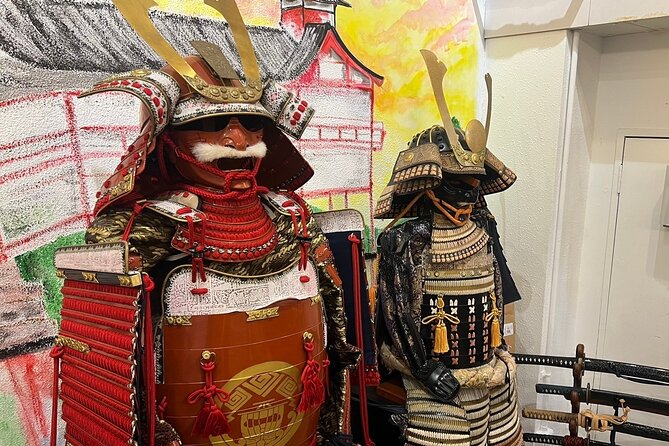
One of the strongest parts of the session is watching the students and master cut rolled tatami mats with a real katana. This is known as test cutting. It demonstrates that the result depends on alignment, angle, control, and a clean motion, not brute strength alone.
For you, this is a chance to see the gap between practicing a movement and applying it to a real target. The cutting display also explains why participants are not simply handed a sword and told to have fun. A real blade demands caution and proper instruction.
There is an important limit: participants do not perform test cutting. You may watch the students and master, but you will not cut rolled tatami yourself. Some people will see that as a missed thrill. I see it as a sensible boundary for a short introductory session involving a real katana.
The demonstration should be one of the most memorable visual moments of the day, but the lesson leading up to it is just as important. Without the earlier work on stance and control, the cutting would look like a trick rather than a skill.
The master’s two-katana performance
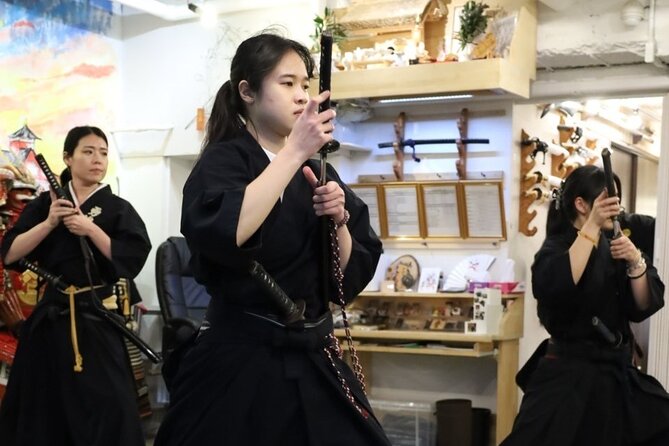
The master also performs with two katana. This is presented as a special feature of the session, and it gives the experience a distinct finish. Watching one sword handled with care is already different from a tourist show. Watching two adds another layer of coordination and control.
You should treat this as a demonstration, not a promise that you will learn two-sword techniques yourself. The practical instruction centers on iai and kenjutsu, while the two-katana performance belongs to the master’s presentation.
This is also the point where the session combines education and spectacle. Most of the time, you are learning how disciplined practice works. Then you get to see an advanced display that places those fundamentals in a larger frame.
What the price means at $195.09
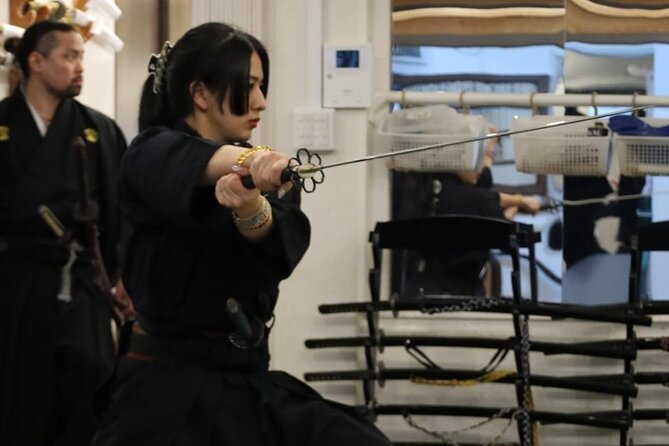
At $195.09 per person, this is not a budget activity. The price makes more sense if you value access to a working dojo, a group capped at three people, proper training clothing, direct instruction, and a master’s demonstration. You are paying for a specialized class, not simply for an hour of entertainment.
The three-hour duration helps the value. You have time to change, learn, practice, watch the dojo students, and see the cutting demonstrations. A shorter photo session might cost less, but it would not offer the same amount of structured contact with the training environment.
Still, the price may feel high if your main goal is to wear samurai clothing or watch a sword show. Kyoto has many cultural activities, and this one is aimed at people who want a serious introduction to sword practice. You should book it because of the training, not because the words samurai and katana sound exciting on a schedule.
A mobile ticket makes entry easy, but it does not change the nature of the visit. Bring your attention, follow directions, and treat the dojo as a place of practice.
Who will get the most from this session
I would choose this for an adult or teenager aged 12 and older who has a real interest in martial arts, Japanese swordsmanship, or disciplined cultural activities. Someone with prior martial arts experience may find the technical approach especially satisfying, though previous katana training is not stated as a requirement.
It can also suit a curious first-timer who understands that progress will be modest during one three-hour class. You do not need to arrive as an expert. You do need patience and a willingness to repeat basic movements carefully.
I would hesitate to recommend it to anyone seeking a casual group activity, a photo opportunity, or a hands-on cutting challenge. Video recording is forbidden, observing without paying is not allowed, and participant test cutting is not offered. Those rules are clear signs that the dojo protects its training environment.
The activity also works best for someone comfortable with a moderate physical demand. Since the class may require standing and repeated movement, you should not treat it as a passive performance.
Practical planning for your Kyoto day
Plan to arrive at the meeting point in Nakagyo Ward with enough time to find the address. The session begins and ends at 452-4 Matsugaechō, and the location is near public transportation, so it can fit into a larger day in central Kyoto.
Do not schedule a rushed train departure immediately afterward. The stated duration is approximately three hours, and the experience includes several distinct parts. Give yourself a little breathing room before your next appointment.
The booking confirmation arrives within 48 hours, subject to availability. Because the class accepts only three participants and is commonly booked well ahead, choose your date early if this is a priority.
Cancellation is free up to 24 hours before the start time for a full refund. Cancellations or changes made less than 24 hours before the start are not accepted for a refund. The cut-off follows local Kyoto time.
Should you book the Yushinkan Kyoto experience?
Book it if you want a close look at serious katana training, value a very small group, and are happy to learn rather than simply pose. The chance to train beside local students, watch real tatami cutting, and see the master’s two-katana performance gives the session unusual depth for a short Kyoto activity.
Skip it if you mainly want to record a dramatic video, cut a target yourself, or enjoy a low-effort attraction. At $195.09, the price demands genuine interest. For the right person, this is a focused and memorable introduction to dojo practice. For everyone else, it may feel too formal and too expensive.
FAQ
Where does the katana training take place?
The activity takes place at Yushinkan Kyoto, at 452-4 Matsugaechō, Nakagyo Ward, Kyoto, 604-8034, Japan.
How long does the experience last?
The session lasts approximately three hours.
Does the activity begin and end at the same location?
Yes. The experience ends back at the meeting point.
How many people can join?
The activity has a maximum of three participants.
What will I wear during the training?
You will wear samurai training gear consisting of a dōgi, obi, and hakama.
What techniques will I learn?
The session includes iai, or katana drawing techniques, and kenjutsu, or katana fighting techniques.
Can I cut rolled tatami mats?
No. You can watch the students and master cut rolled tatami mats with a real katana, but participant test cutting is not offered.
Can I record video during the session?
No. Video recording is not allowed.
What is the minimum age and fitness requirement?
Participants must be at least 12 years old, and a moderate level of physical fitness is recommended.
Just added around Japan
- Train in Samurai Swordsmanship and Defeat the Demon in Tokyo★ 5.0 · 5 reviews
- Private tour with Yasushi and Yoko – by car, train, on foot★ 5.0 · 2 reviews
- Mt Fuji & Hakone Private Tour from Tokyo: Return by Bullet Train★ 5.0 · 22 reviews
- Tokyo-Izu: Volcano, Ocean& Capybara Cuddle with Izu Scenic Train★ 3.5 · 3 reviews
- Bullet Train and Mt. Fuji Famous Food Tour★ 5.0 · 4 reviews
- Bullet Train Experience & Mishima Shrine Private Tour from Tokyo★ 5.0 · 9 reviews
- 3-Day Private Tokyo and Nagano: Snow Monkeys, Tsukiji Market and Bullet Train★ 5.0 · 2 reviews
- Guided Half-day Tour(PM) to Toyota Commemorative Museum & SCMAGLEV Railway Park★ 5.0 · 3 reviews
Kyoto Train Journeys, compared.
Arashiyama Day Tour with Train, Boat, and Onsen
Read our review →
Kyoto Bus Tour: Sagano Railway & Hozugawa River Boat Ride
Read our review →
Arashiyama Tour with optional Sagano Romantic Train
Read our review →
Kyoto Hozugawa River Boat Sagano Romantic Train Tour
Read our review →
Kyoto Sagano Romantic Train in Arashiyama Bus Tour
Read our review →
Browse the lists this tour appears in